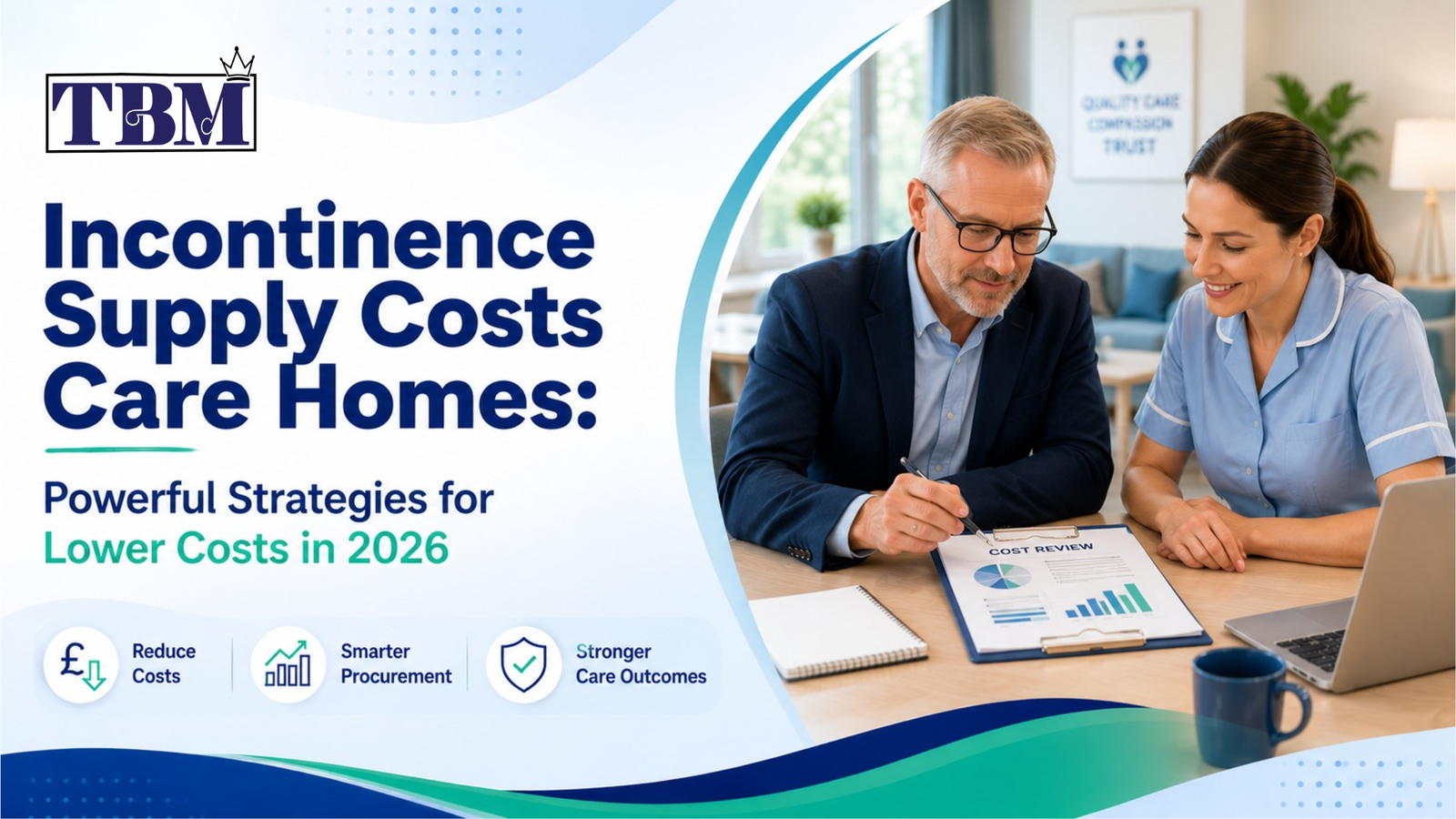
Incontinence supply costs care homes UK represent one of the most significant and controllable line items in a care home’s annual budget. Yet many operators are paying more than they need to, not because of poor intentions, but because of outdated procurement habits, fragmented ordering, and a lack of visibility into total supply chain costs.
This article examines the practical strategies that forward-thinking UK care homes are deploying in 2026 to reduce incontinence supply costs care homes UK without cutting corners on resident dignity, comfort, or clinical outcomes. Each strategy is actionable from this week, requires no capital investment, and has been validated by real care procurement experience.
Quick Questions & Answers
| Q: What are the biggest drivers of high incontinence supply costs care homes UK?
A: The three biggest cost drivers are: retail-price purchasing at care-home volumes (which should be trade-priced), poor product-resident matching (over-specifying products for residents with lighter needs), and emergency or ad hoc purchasing triggered by supply failures. All three are controllable with better procurement practices. |
| Q: Can you reduce incontinence supply costs care homes UK without affecting resident dignity or care quality?
A: Yes — and this is important to state clearly. The cost-reduction strategies that work best (bulk buying, right-sizing product mix, claiming VAT relief, consolidating suppliers) are efficiency improvements, not quality reductions. In many cases, better procurement actually improves care consistency by reducing supply gaps. |
| Q: What is a realistic target for cost reduction on incontinence supply costs care homes UK?
A: Care homes that move from retail purchasing to trade pricing, conduct a product-mix audit, and claim eligible VAT relief can typically achieve 30–50% cost reductions on their incontinence supply spend without changing which residents receive which level of care. |
Understanding What You’re Actually Spending
The first step to reducing incontinence supply costs care homes UK is establishing a clear picture of current expenditure. Many care homes have not conducted a detailed audit of incontinence procurement in years. Costs are often buried across multiple budget lines — consumables, clinical supplies, laundry — making the true total difficult to see.
A useful framework is to calculate cost-per-resident-per-day across all incontinence product categories. This single metric enables meaningful comparison across suppliers, product types, and ordering strategies — and makes it straightforward to quantify the financial impact of any changes made.
For accurate cost modelling, TBM Trading’s trade pricing is clearly published online with no hidden minimums, making it easy to run comparison calculations before switching.
Strategy 1: Move to Bulk Trade Purchasing
One of the most immediate ways to reduce incontinence supply costs care homes UK is transitioning from small, frequent retail purchases to larger bulk orders at trade prices. Buying in packs of 10 or 20 from consumer platforms at retail prices is enormously expensive at care home volumes.
Switching to trade packs of 50 or 100 units from a wholesale supplier typically cuts per-pad costs by 30–50%. TBM Trading offers packs of 50 from £9.99 and packs of 100 from £20.00 with free UK delivery — making this one of the most accessible cost improvements available to care homes still sourcing at retail.
See current bulk options at the TBM Trading Incontinence Shop.
Strategy 2: Right-Size Your Product Mix
Over-specification is a common and costly contributor to high incontinence supply costs care homes UK. If a resident requires light absorbency management but is receiving a premium heavy-duty product, you’re paying a significant premium for capacity that goes unused.
Regular product reviews, ideally incorporated into individual care planning, allow product specification to be matched to actual resident need. A structured approach categorises residents into light, moderate, and heavy incontinence need profiles, then ensures the products stocked reflect the actual distribution across those categories.
This is not about compromising care, it is about being precise about it. Residents with lighter needs are often more comfortable in lighter products, and the savings can be reinvested into other aspects of care delivery.
Strategy 3: Eliminate Emergency and Ad Hoc Purchasing
Emergency purchasing, placing a premium delivery order because supplies have run out, is one of the largest hidden contributors to high incontinence supply costs care homes UK. Per-unit costs for emergency retail purchases can be three to five times higher than planned trade purchasing.
The fix is straightforward: maintain a two-week rolling stock buffer and use a supplier that dispatches same-day for orders placed before 3pm. Most care homes can eliminate emergency purchasing almost entirely with these two changes in place.
TBM Trading’s same-day dispatch policy ensures orders placed before 3pm are sent the same day. Contact the team via the TBM Trading Contact page to discuss supply scheduling.
Strategy 4: Claim VAT Relief Where Eligible
VAT relief is one of the most underutilised cost-saving mechanisms in incontinence supply costs care homes UK. Under UK law, incontinence products designed for chronically sick or disabled individuals can be purchased VAT-free by eligible buyers. At a 20% standard VAT rate, this saving on a significant monthly spend is material.
Care homes should review eligibility with their finance team and confirm their supplier processes VAT relief declarations correctly. TBM Trading handles VAT relief automatically at checkout for qualifying orders, making this saving accessible without additional administrative complexity.
HMRC’s guidance on VAT relief for disabled people provides definitive eligibility criteria and the legal basis for claims.
Strategy 5: Consolidate Your Supplier Base
Many care homes source incontinence products from multiple suppliers, one for bed pads, another for pull-up briefs, a third for skin care. While this may have evolved for historical reasons, it creates administrative overhead, multiple delivery slots, fragmented pricing leverage, and inconsistent quality management — all of which add to incontinence supply costs care homes UK.
Consolidating into one or two core suppliers simplifies procurement, improves pricing leverage, and reduces the management burden on care staff and administrators.
TBM Trading offers a focused, high-quality range designed to serve as a single-source supplier for core incontinence care needs. Explore the B2B Solutions page for information on trade supply arrangements.
Strategy 6: Use Data to Negotiate Better Terms
Care homes that can demonstrate their purchasing volumes, monthly units, annual spend, product mix — are in a much stronger position to negotiate trade pricing and account terms with suppliers. Many operators leave significant savings unrealised simply because they have not had the commercial conversation.
Prepare a simple procurement summary: average monthly units by product type, total annual spend estimate, and any flexibility in delivery scheduling. This data is the foundation for a genuine commercial negotiation rather than passive acceptance of standard pricing.
The Balance: Cost Reduction Without Compromising Dignity
It is worth being explicit: incontinence supply costs care homes UK can be reduced substantially without any compromise to resident dignity or care quality. Every strategy in this guide is an efficiency improvement — not a quality reduction.
In fact, the most reliable suppliers, consistent quality, fast dispatch, strong trade pricing, typically deliver better care outcomes than fragmented, inconsistent sourcing. Reliability and quality are not in conflict with cost management; they are the same goal approached intelligently.
For further clinical context, the NHS Improvement continence care resources provide a best-practice foundation that sits alongside good procurement strategy.
Frequently Asked Questions
| How do I calculate our current incontinence supply costs care homes UK accurately?
Start by pulling together all purchases across every supplier and budget code for the past three months. Calculate total spend divided by resident-days over that period to get a cost-per-resident-per-day figure. Then multiply by 365 for an annualised baseline. This single metric is the most useful benchmark for measuring the impact of any procurement changes you make. |
| What is a typical cost-per-resident-per-day for incontinence products in a UK care home?
This varies significantly by resident dependency level and product mix. A well-managed care home with a right-sized product mix and trade pricing typically achieves £0.50–£1.20 per resident per day for incontinence supplies including bed pads and absorbent products. Homes still buying at retail often see figures two to three times higher. |
| How quickly can we see cost savings after switching to a trade supplier?
Savings are typically realised from the first order. Switching from retail to trade-pack pricing on bed pads alone often delivers a 30–50% per-unit cost reduction immediately. VAT relief savings, if newly claimed, reduce effective costs by a further 20% on qualifying purchases. |
| Does buying cheaper incontinence products risk CQC compliance?
Buying cheaper products is not inherently a compliance risk — buying poor-quality products is. The distinction matters. Trade-priced products from reputable suppliers like TBM Trading maintain quality specifications. CQC inspects whether residents receive appropriate, dignified continence care — which is best supported by reliable supply of quality-consistent products, not by paying retail prices. |
| How do we manage the transition from multiple suppliers to one primary supplier?
The smoothest approach is to run a parallel trial period — continue with existing suppliers for one month while trialling the new primary supplier for a defined product category. Review quality, delivery reliability, and total cost over that period, then migrate the remaining categories once satisfied. Maintain a small contingency stock buffer during the transition period. |
| Can small care homes (under 20 beds) access trade pricing for incontinence supply costs care homes UK?
Yes. TBM Trading’s trade pricing is accessible from single pack orders with no minimum spend requirement, making it equally viable for small homes as for large groups. A 15-bed home can buy packs of 50 or 100 at the same per-unit trade price as a 200-bed operator. |