The single most common reason puppy pad training fails is that the pad is too small. For medium and large breed dogs, a standard 60x60cm pad doesn’t provide enough surface area for a reliable hit — and when your Labrador or German Shepherd misses the edge of a pad three times in a row, the training association breaks down and the frustration builds. The solution is straightforward: use an XL pad. This guide explains why size matters so much, which UK breeds need XL pads, and how to buy in bulk without overspending.
Why Standard Pads Fail Large Breed Puppies
A standard puppy training pad in the UK is typically 60x60cm — 0.36 square metres of absorbent surface. For a Chihuahua or Shih Tzu, that’s a generous target. For a 12-week-old Labrador Retriever, it’s a postage stamp.
Large breed puppies have longer bodies, wider stances, and less precise spatial awareness in early training. A Lab puppy at 12 weeks weighs around 6–8kg and measures 40–50cm from chest to rump when squatting. Place that on a 60x60cm pad and there is barely 5–10cm of margin on each side. Any slight misalignment — and misalignment is the norm in early training, not the exception — results in a miss.
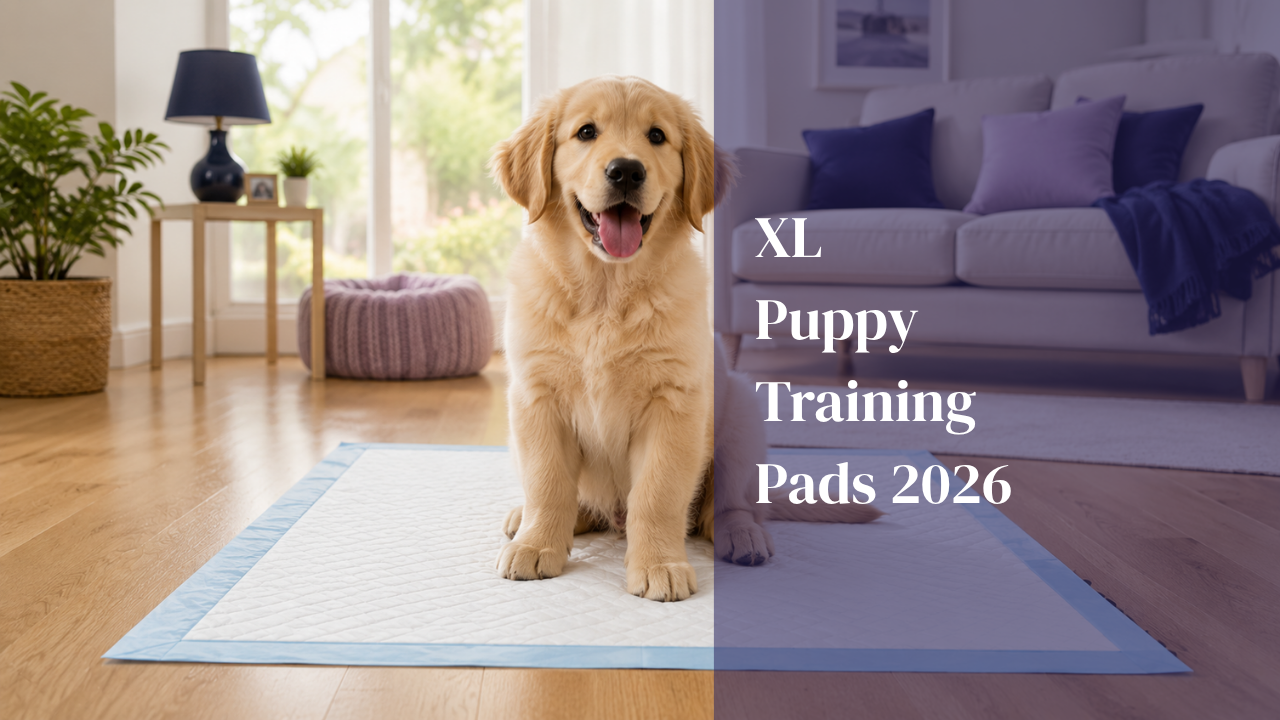
XL puppy pads at 60x90cm give 0.54 square metres of coverage — 50% more surface area than standard pads. For a squatting large breed puppy, that 30cm of extra length is the difference between a consistent hit and a consistent miss. Consistency is the entire foundation of pad training. Without it, the association between the pad and the correct toileting location cannot form reliably.
For expert context on how puppies develop spatial habits during training, the Kennel Club’s puppy training guidance covers the learning behaviour behind toilet training in detail.
Which UK Breeds Need XL Puppy Pads
As a practical guide, any puppy expected to reach an adult weight of 15kg or above should be trained on XL pads from the start. Switching from standard to XL mid-training adds confusion to an already-developing habit.
Breeds that need XL pads from week one:
Labrador Retriever, Golden Retriever, German Shepherd, Border Collie, Boxer, Springer Spaniel, Dalmatian, Weimaraner, Standard Poodle, Siberian Husky, Rottweiler, Doberman, and any mixed breed expected to reach medium-to-large adult size.
Breeds where XL is beneficial but standard may work:
Cocker Spaniel, Beagle, Whippet, French Bulldog (standard works for some, XL gives more margin), Staffordshire Bull Terrier, Miniature Poodle.
Breeds where standard 60x60cm is sufficient:
Chihuahua, Dachshund, Yorkshire Terrier, Shih Tzu, Bichon Frise, Pomeranian, Toy Poodle, Miniature Schnauzer.
If you’re unsure which size your puppy needs, err toward XL. The cost difference per pad is minimal and the reduction in missed accidents is significant. TBM’s XL puppy training pads 60x90cm pack of 50 is a good starting point at £12.99 before committing to a larger bulk order.
The Science of Why Pad Placement and Size Work Together
Understanding why your dog uses the pad consistently — or doesn’t — comes down to scent association and consistent positive reinforcement. Puppies are drawn back to areas where they have previously toileted by scent. The SAP core in TBM XL pads absorbs and partially neutralises urine odour, but retains enough residual scent to cue the puppy back to the same spot on the next visit.
This is why the size of the pad and its fixed placement work together. A large pad that stays in one location gives the puppy a larger scent-marked target to return to. A small pad that shifts position — or that the puppy regularly misses — creates a diffuse scent pattern across the surrounding floor, making it harder for the puppy to identify the correct spot.
The PDSA’s toilet training guide for puppies covers the scent and reinforcement science of toilet training in practical detail that complements the choice of pad size.
How Many XL Pads Do You Actually Need
The biggest mistake new puppy owners make is underestimating how many pads they’ll go through in the first six weeks. Here is a realistic guide:
Weeks 1–3 of training: A puppy toilets every 1–2 hours during waking hours, and typically 2–3 times overnight. Expect 6–10 pad uses per day in this phase. Not every use warrants an immediate change — a single-use pad can typically accommodate two to three small puppy voids — but plan for 4–6 pad changes per day minimum.
Weeks 3–6: Frequency begins to drop as bladder control improves. 3–5 pad changes per day is typical.
Weeks 6–12: As outdoor training takes over from pad training, pad usage typically falls to 1–3 per day for indoor accidents only.
Based on this, a pack of 50 XL pads lasts approximately 8–12 days in weeks 1–3, and two to three weeks in weeks 6–12. A pack of 100 XL pads at £20.00 at 20p per pad covers three to four weeks of early training — a much more economical approach than buying small packs repeatedly.
XL vs Standard — The Cost Comparison
Some owners assume XL pads cost significantly more than standard pads. The reality is the difference is minimal per pad, and the reduction in floor cleaning time, carpet treatment costs, and training setbacks makes XL pads significantly more economical in practice.
| Pack | Size | Pads | Price | Per Pad |
|---|---|---|---|---|
| Standard Pack of 50 | 60×60cm | 50 | £7.99 | 16p |
| Standard Pack of 100 | 60×60cm | 100 | £14.50 | 14.5p |
| XL Pack of 50 | 60×90cm | 50 | £12.99 | 26p |
| XL Pack of 100 | 60×90cm | 100 | £20.00 | 20p |
The XL pack of 100 at 20p per pad is 5.5p more per pad than the standard pack of 100. For 5 pad changes per day, that’s a 27.5p per day difference — less than 30p per day for the coverage and training reliability benefit an XL pad provides for a large breed puppy.
For owners with smaller breeds or those on tighter budgets, the standard 60x60cm pack of 100 at £14.50 remains excellent value for breeds where the standard size is genuinely sufficient.
Crate Training With XL Pads
XL pads are particularly useful for crate training because they fit the floor of a large dog crate without needing to fold. A standard large dog crate (typically 100–110cm long) accommodates a 60x90cm pad lengthwise with 10–20cm to spare. This means the pad stays flat, doesn’t bunch at the edges, and provides full crate floor coverage.
For crate training technique, the RSPCA’s guidance on crate training puppies is a well-regarded resource on how to introduce the crate positively alongside pad training.
When using pads inside a crate, place the pad at the end of the crate furthest from where the puppy sleeps. Dogs instinctively avoid toileting near their sleeping area — positioning the pad at the opposite end of the crate works with this instinct rather than against it.
Non-Slip Base — Why It Matters on Hard Floors
Most UK homes have a combination of hard floors (kitchen, hallway, bathroom) and carpeted areas. Puppy pads are typically placed on hard floors during training — and a pad that slides on a hard floor undermines the entire training process.
TBM XL puppy pads have a textured PE film base that grips hard floors, laminate, and tiles without the pad being taped or weighed down. If you’ve used cheaper puppy pads that slide when your puppy steps on them — or that scrunch up at the edges because the backing is too thin to lie flat — the difference a properly constructed non-slip base makes is immediately noticeable.
Transitioning From XL Pads to Outdoor Training
The goal of pad training is always to transition the puppy to outdoor toileting. XL pads can support this transition in two ways. First, you can gradually move the pad closer to the door over several weeks — 15–30cm per day — so the puppy follows the pad’s location toward the exit. Second, you can place the pad just outside the door initially, bridging the indoor-outdoor gap before removing it entirely.
Most medium and large breed puppies are ready to begin this transition at 12–16 weeks, once they have enough bladder control to hold for short periods and respond to a regular outdoor routine. Our 7-day puppy pad training guide covers the transition process step by step.
Frequently Asked Questions
What size puppy pad do I need for a Labrador or Golden Retriever?
Labradors and Golden Retrievers need XL puppy pads from the first week of training. The 60x90cm XL pad gives enough surface area for a large breed puppy’s squatting position with adequate margin for positional variance. Standard 60x60cm pads are too small for these breeds and will result in frequent missed accidents.
Are TBM XL puppy pads non-slip on hard floors?
Yes. TBM XL 60x90cm puppy pads have a textured waterproof PE film base that grips hard floors, laminate, and tiles without sliding. This is particularly important for large breed puppies whose movement onto the pad creates more displacement force than a smaller dog.
How long does a pack of 100 XL puppy pads last?
At 5 pad changes per day — typical for early training — a pack of 100 XL pads lasts approximately 20 days. At 3 changes per day in later training weeks, a pack of 100 lasts approximately five weeks.
Do XL puppy pads control odour?
Yes. TBM XL puppy pads include an odour-neutralising SAP polymer core that chemically traps ammonia compounds on absorption. This significantly reduces the urine smell compared to basic absorbent pads that only contain liquid.
Can I use XL puppy pads for an older dog with bladder control issues?
Yes. TBM XL 60x90cm pads are widely used for senior dogs with age-related bladder control issues, dogs recovering from illness or surgery, and dogs with mobility limitations that prevent regular outdoor access. The same pad is used across TBM’s incontinence and pet care ranges.
TBM Trading supplies XL and large puppy training pads across the UK with free delivery on all orders. Browse the full puppy training pads range or contact us at info@tbmtrading.com | +44 7351 161834.